











Share With Your Circle
If you’ve noticed menu prices creeping up, or seen a new wave of high-tech food trucks hitting the streets, you’re not imagining it. The food truck industry is undergoing a major shift, and 2026 is shaping up to be a defining year.
On paper, the industry is booming. In practice, survival now requires smarter strategy, tighter operations, and deeper community connection.
Here’s what the data is telling us.
The Big Picture
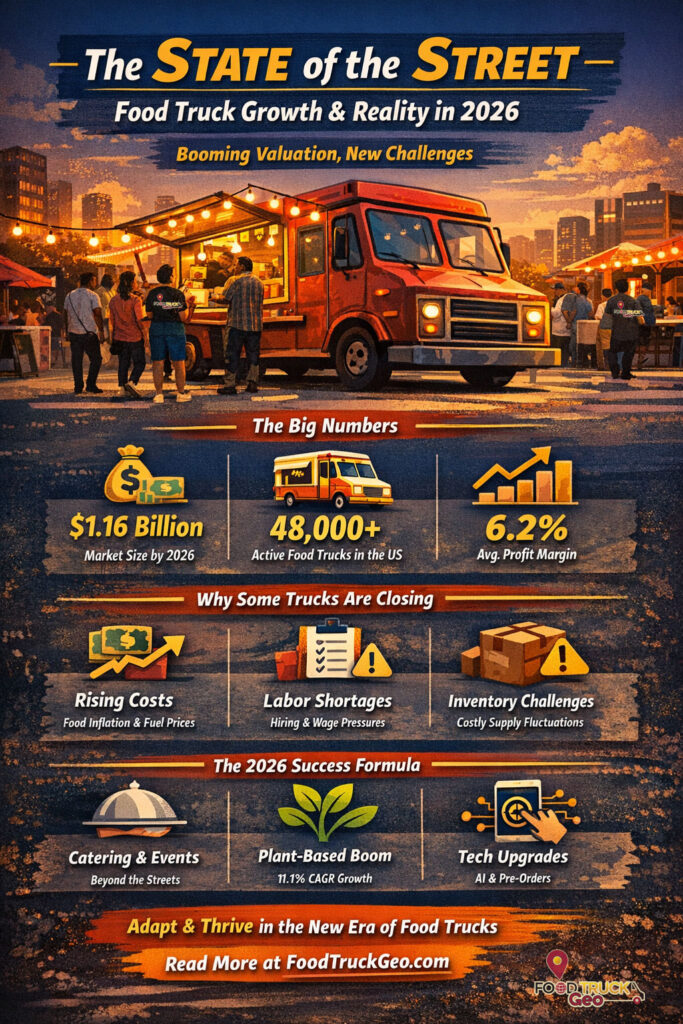
The U.S. food truck industry is projected to reach $1.16 billion in market value in 2026, with more than 48,000 active food trucks operating nationwide. Growth is expected to continue at a 6.5% compound annual rate through 2031.
Compared to brick-and-mortar restaurants—where five-year failure rates can reach 60–80%—food trucks continue to show greater resilience due to lower overhead and operational flexibility.
Average profit margins for food trucks hover around 6.2%, significantly outperforming traditional full-service restaurants, which often sit between 1–3%.
Why Some Food Trucks Are Struggling
Despite strong demand, many operators are feeling squeezed. The biggest threats aren’t lack of customers—they’re operational pressures.
Price Sensitivity Is Rising
Food-away-from-home inflation has climbed roughly 3–4% annually, making customers far more value-conscious.
Labor Is Harder to Secure
Hiring and retention remain top challenges, with food truck wages rising nearly 15% since 2019.
Inventory & Fuel Volatility
Protein costs, fuel prices, and supply-chain fluctuations have driven operating costs up nearly 8% year-over-year.
The 2026 Success Formula: Hybrid Kitchens
The trucks winning in 2026 are no longer relying solely on street vending. They’re evolving.
(A) Catering-First Models:Top-performing trucks now generate up to 35% of revenue from catering and private events.
(B) Niche Dominance: Plant-based and vegan concepts are growing at an 11.1% CAGR, outpacing traditional fast-casual trucks.
(C) Technology & Data Integration:Nearly 28% of operators are investing in tech-driven inventory management, pre-order systems, and
demand forecasting to reduce waste and maximize margins.
Owner Insight
2026 is the year food truck operators must think beyond locations.
Community data, customer behavior, and loyalty patterns now matter as much as menus. Platforms like Food Truck Geo help operators understand when, where, and why customers show up—so decisions aren’t made blindly.
The future belongs to trucks that build relationships, not just lines.
What’s the best new food truck you’ve discovered this year? Drop a shoutout in the comments.
Catch up on Food Truck Geo News
The State of the Street: Food Truck Growth & Reality in 2026
Food truck industry trends in 2026 reveal strong growth alongside rising costs, labor challenges, and changing customer behavior. Learn how successful food trucks are adapting through catering, niche concepts, and community-driven strategies.
Let's Talk!
Comments